Almost 20 years ago, the adaptation of the Broadway musical Mamma Mia was released into movie theaters. Outside of my family of two, few would probably describe the film as a great musical. On some level, I would tend to agree with them. Like many jukebox musicals, Mamma Mia has structural problems. Yet I’d argue that its cast make up for these failings and speaks to how taking a gamble with your actors can sometimes richly pay off.
So, what then makes a jukebox musical great? It’s a lot of things, of course. But I’d say it’s songs must feel integral to the plot or credibly develop its characters. At the very least, they must align in some form or fashion with what we are seeing on screen while they are transpiring. They absolutely should not be shoehorned in just because they are catchy or memorable. For my money, no jukebox musical does this better than Moulin Rouge. Baz Luhrmann’s 2001, Oscar-nominated classic is packed with fantastic music and is a great listen from start to finish. Each song also serves a specific purpose. They realistically flesh out the characters’ psychologies and emotional journeys and put a fine point on its overarching ode to love. As an added bonus, because of the play within a film structure, they also often work on a diegetic level as well. The musical scenes sometimes pop up in a way they theoretically could in the real world, not just in the heightened reality of a musical.
If you surveyed the general populace, you probably wouldn’t find too many people who would claim that 2008’s Mamma Mia is in the same league as Moulin Rouge. For one thing, Mamma Mia is much more of a romp than Moulin Rouge, and its themes and characters much more thinly sketched. More importantly, Mamma Mia’s songs are often far less effective in pushing the film’s plot forward or depicting characters’ inner lives in a way that feel grounded in emotional truth.
To be fair, Mamma Mia is a better jukebox musical than something like Rock of Ages. When conceiving of the stage show on which the Mamma Mia is based, producer Judy Craymer came up with an idea that allowed a bulk of ABBA’s catalog to be stitched together into a coherent and somewhat sensible show. The play’s plot concerns Sophie (Amanda Seyfried), a 20-something bride-to-be, and her mother Donna (Meryl Streep), who runs a failing hotel in Greece. Their lives are upended when Sophie secretly invites Sam, Harry and Bill (played by Pierce Brosnan, Colin Firth and Stellan Skarsgård respectively) to her upcoming wedding. These three men each had a relationship with Donna at roughly the same time 20 years ago, and all are equally possible candidates to be Sophie’s father.
By centering the show primarily on two generations of women, ABBA’s “earlier, more youthful songs about falling in love”1 could be organically used during parts of the play featuring Sophie. And the “later ones about falling out of love”2 were a natural fit for Donna’s arc. But even with such a solid core in place, there remains several songs that feel more ornamental than integral in the film. That’s where the film’s unconventional casting serves as its secret weapon. Many of the cast had no real formal musical experience prior to being cast. But what they bring to the table not only makes up for this personal deficiency but the film’s as well.
Take Julie Walters as first example. Walters was a veteran of film, television and theater when she was cast as Rosie, one of Donna’s best friends from her college days. She is best known to sad, self-medicating millennials everywhere for playing Molly Weasley in Harry Potter and uttering the now cringe-worthy zinger of “Not my daughter, you bitch!” before blowing Bellatrix Lestrange to kingdom come. What she was not a veteran of was musicals, aside from a few minor roles in productions like Acorn Antiques: The Musical! and two little-seen musical TV films in the 70s and 80s. Even still, she makes the most out of her character’s lone moment in the spotlight during the film’s final song: “Take a Chance on Me.”
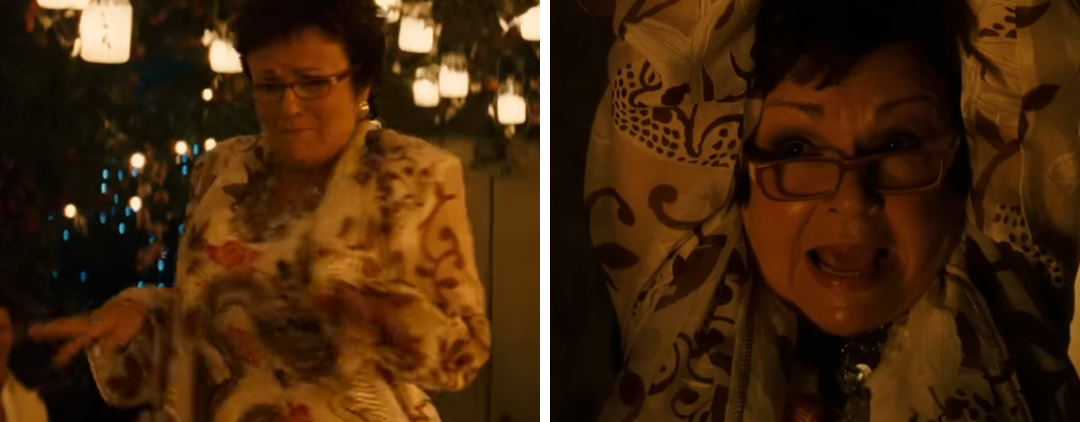
This is good news because “Take a Chance on Me” is one of Mamma Mia‘s least effective musical scenes. It appears after the film’s main narrative has concluded, making it feel like it was included solely for being recognizable to mass audiences rather than relevant to the film’s story. Even still, Walters’ performance is so exuberant, so silly, so devoid of ego, that the vignette retains ample entertainment value despite being no more substantive than a deleted scene. Her willingness to be put in absurd, over-the-top positions, such as when she’s literally hanging from Skarsgård’s legs over the side of a house, make it impossible to be too mad about the song’s superfluous and unnecessary nature.
Pierce Brosnan was similarly a musical newbie when he got offered the role of Sam Carmichael. He had recently come off his run as Bond with 2002’s woeful misfire Die Another Day and had been mostly playing Bond-adjacent types like After the Sunset (2004) and The Matador (2005) ever since. Mamma Mia represented something utterly new for the actor, and according to critics at the time, it was something at which he failed miserably. Not only did he wind up getting nominated for a Razzie award for his performance, but his singing was savaged in reviews. My favorite take down has to be one commentator who said his singing was so bad it was if Brosnan was being subjected to a colonoscopy off-screen.
While on one hand these reactions to Brosnan’s Mamma Mia work are sorta’ funny, they’re also undeniably mean. On top of that, they are disproportionate to the quality of performance he actually delivers in the film. Brosnan just isn’t that bad in Mamma Mia. What’s more, he anchors one of the pivotal musical scenes in the film, “SOS,” which sees Sam recognizing he still cares for Donna and trying to reconnect with her. “SOS” is a banger of an ABBA song. Tight. Punchy. And incredibly memorable. Unfortunately, in the context of Mamma Mia itself, it doesn’t really make all that much sense, especially when you give the lyrics a gander. The key lines that start off the song are these:
Where are those happy days, they seem so hard to find
I tried to reach for you, but you have closed your mind
Whatever happened to our love
I wish I understood
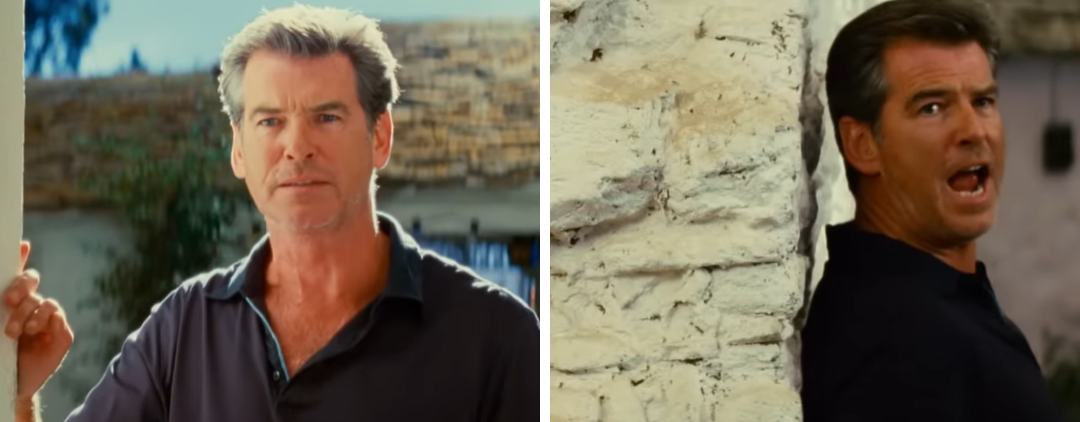
These lines are problematic because Sam actually does completely understand what happened to the love he shared with Donna two decades ago. We learn during the film that, while Sam was having his fling with Donna, he also had a fiancé waiting for him back in England. In the film’s wonderful and equally big-hearted sequel, Mamma Mia: Here We Go Again, which also functions in part as a prequel depicting Donna as a young woman, we see this for ourselves. When Donna discovers the truth about Sam’s situation, she is understandably incensed. She breaks things off with young Sam, and the little twirp absconds back to England to lick his wounds and get hitched.
With this additional context, it’s clear that lyrics like these don’t accurately depict the emotional dynamic between Donna and Sam. And so, we’re left with another song included for its popularity more than anything else. But Brosnan’s performance makes the scene still work and communicates the intent its lyrics muddle. His sad, desperate eyes; frustrated movements; and ragged singing combine to counteract the head-scratching words. They create an absorbing portrait of someone who really does seem confused, sad and regretful for having wound up in a fractured relationship with someone they care about. The great psychologist Albert Mehrabian once said, “It’s not about what you say, it’s about how you say it,” and Brosnan’s performance in “SOS” once again proves the truth of those sentiments. You may recognize the words as false, but the underlying emotion rings true.
Both Walters and Brosnan deftly show how much skilled actors can compensate for somewhat poorly curated songs, even if they are nascent singers. Perhaps unsurprisingly, the cast member who makes the most significant contribution in this regard is the one and only Meryl Streep. Although Streep had only rarely dipped her toes into musicals with films like 2006’s The Prairie Home Companion, her layered work in Mamma Mia is one of the film’s biggest highlights. She makes Donna not only a bright, likeable presence, but also a layered one. Her raw skill as an actor easily makes up for her rather thin singing voice and even turns one of Mamma Mia‘s most obviously shoe-horned songs into one of its most impactful: “Super Trouper.”
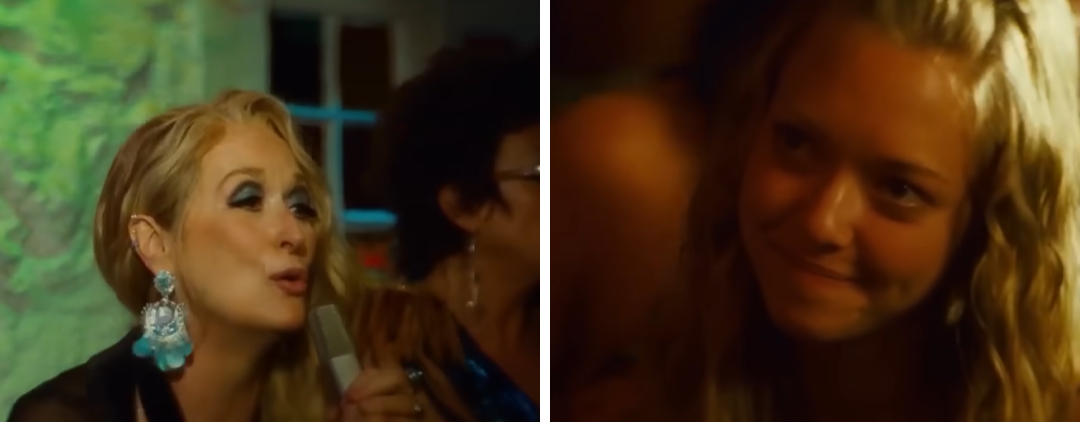
ABBA’s “Super Trouper” debuted in 1980 and went on to become of the group’s highest selling singles. It tells the story of a chronic traveling performer who is feeling alienated and lonely and is missing an unnamed lover. In Mamma Mia, the song shows up in a completely different context. Sophie is in the midst of having her “hen party” prior to her wedding. To do something special for her, Donna enlists her life-long friends Rosie and Tanya (Walters and the wonderful Christine Baranski, respectively) to reunite as their college group, “Donna and the Dynamos,” for one night and sing “Super Trouper” to Sophie and her gaggle of friends. It’s a sweet idea, but the lyrics don’t match up. What makes it work is Streep’s obviously committed performance. She is deeply present in the scene and radiates an undeniable maternal warmth and love toward Seyfried’s Sophie. Their affecting chemistry is so abundantly palpable that the fact the lyrics are describing an entirely different type of relationship becomes a moot point.
These examples reveal how effective casting often comes down to something less tangible than whether someone checks an obvious button like being able to sing really well. Phyllida Lloyd noted that Julie Walters was the right choice for Rosie not necessarily for her range but because she understood the “balance” of the piece, where you could swerve from “unexpected poignancy to “the Looney Tunes of it all.”3 When it came to casting Sam, the filmmakers chose Brosnan not for his sterling pipes but because Sam is someone who needs to have “huge charisma” and “be great character [actor].” The role does require someone to “sing and dance,” said Lloyd “except they [don’t] really have to.”4 And with Meryl, the filmmakers pursued her because she had a deep passion for the original stage show more than anything else. “Meryl […] felt so enthusiastic about the project,” said Craymer. “She’d never done a musical before, and it was something she really wanted to conquer.”5 The message Meryl’s enthusiasm sent was that Mamma Mia was a project she cared about and one where she certainly wasn’t going to phone it in. She was going to do what she did best, which is find ways to capture the emotional truth of the piece no matter what was on the page.
In each case, these choices were a gamble for something like a movie musical. Yet not only did they not harm the film, but they in fact also saved it from its own structural flaws. They brought compelling joy to more meaningless songs like Take a Chance on Me and found the genuine heart in more non-sensical beats like SOS and Super Trouper. And in the end, they proved that you don’t always need booming baritones, saintly sopranos or angelic altos in your movie musical. If you trust your gut and boldly cast a film the way you know is right, you can still make your material sing.
__________________
- Thank You for the Music: An Oral History of ‘Mamma Mia!’ | Vogue
- Ibid
- Ibid
- Ibid
- Ibid
 Adam Mohrbacher