Hello once again to my thousands upon thousands of adoring followers and fans throughout all corners of the world. I know what you’re thinking. When I last signed off, it appeared as though you may have seen and heard the last of ol’ Adam. I had regaled you with countless vignettes from the first 28 days of Adrienne and Adam’s global voyage. I had then suggested I might abandon this blogging endeavor of mine, condemning you to a content void filled with nothing but wailing and gnashing of teeth.
Well, your suffering has now come to a close my dear readers, as I am picking up where we left off. Here, I attempt the even more formidable feat of bringing you up to speed on all we’ve seen and done since we left New Zealand nearly many moons ago.
Perhaps you remember, but last time around I got a bit philosophical. I waxed and waned, blabbed and gabbed and generally got long-winded about history, Hegel and Half Nelson. After that ordeal, I swear to do my darndest to keep things a little closer to home this time around. I will use the trip to talk about something we can ALL relate to: the difficulty of existing in time and strategies for dealing with it.
____________
“You’re going to run into me!” I cried out as the 30th tourist barreled straight toward Adrienne and I with their head down, eyes glued to the phone. It had been a few days since we touched down in Sydney, Australia, and during that time, we had noticed a disturbing pattern. Even on the busiest streets of this massive metropolis, countless tourists had decided to walk while foregoing all use of their eyes. Texting. Snapping. Toking. Gramming. All of these took precedence over spatial and bodily awareness or merely enjoying the sights and sounds of a location that was not their own.
This phenomenon held true even at Sydney’s most notable attractions. “I’M AT BONDI!!!” a bronzed mountain of a man screamed at the top of his lungs. Clearly on a video call or live streaming via an app, the man was holding his phone up and straight out in front of him and was facing completely away from Australia’s famous beach itself.

During our third day in Sydney, Adrienne and I had made the pilgrimage to Bondi Beach. It was a hot and sweaty trip to say the least. But after it was over, our peepers were treated to a beach that was truly magnetic. Lush, sandy beaches. Clear blue skies. And grassy hills that gently sloped down to the water. It was miraculous to behold. Yet a vast swath of visitors couldn’t seem to enjoy it. Instead, phones were out, eyes were glazed, jaws were slack, pictures were being snapped and videos were being taken. In short, they were lost in time, doing something else, somewhere else. Despite being physically at Bondi, they were anywhere but there.
We next experienced this phenomenon while touring the metropolis’s prodigious zoo. Normally, both Adrienne and I are not what you’d call “zoo people.” The idea of gawking at countless imprisoned animals in unnatural environments is not exactly what I’d call a grand day out. That’s not even accounting for the fact that such places are usually inundated with children. All that aside, the Sydney Zoo is known for having a dandy of a platypus on display, an adorable gremlin whose name is Matilda or “Tilly” for short. These animals are near and dear to Adrienne’s big heart. It was her motivation for going. I wanted to see it too, of course. Even if I hadn’t, I would have braved any conditions to see a smile light up her face.
But to get to the platypus, we needed to fight through a sea of people whose last concern was seemingly the animals they had paid a lot of money to access. Smart phones, tablets and watches all flashed and flared throughout each exhibit, but they were particularly bad in front of Tilly’s tank. Rather than simply stand and observe this remarkable little creature as it zoomed and zipped across its terrarium, countless people jostled before standing expressionless, eyes glued to their devices, drool dribbling down their chins as they recorded its every movement. It was a fascinating thing to witness, as you had to wonder whether any of these folks would actually ever review their images and videos after the fact.
This trend would continue throughout our time in Southeast (Thailand, Laos and Cambodia) and Central Asia (Kazakhstan and Uzbekistan) and later in Eastern Europe (Istanbul and then Romania). It didn’t matter if we were standing amidst the immaculate temples of Chiang Rai, wading in the lush waterfalls near Luang Prabang or admiring Transylvania’s fortified cities. Ghoulish figures would be there posing and posting, utterly ignoring the majesty around them while documenting, documenting and documenting some more.
While these people had the latest and greatest technology on hand, what my dear Adrienne and I were witnessing in these moments represented the oldest of all human problems. In 2026, people obsessively take photos and videos for many reasons. One of them is financial, as an entire influencer industry has arisen alongside social media. Another is simply runaway narcissism. To me, the obsessive documenting that is synonymous with modern life represents something deeper—specifically, an underlying fear of death. By taking a photo or video, we attempt to deny the impermanence of life and by extension our own mortality.
Although the people who do this habitually annoy the shit out of me, on some level, I have sympathy for what was likely driving those poor bastards to snap, snap and snap away. The fact that humans must go about their day-to-day lives all while knowing we’re inevitably doomed by time is enough to make anyone go completely fucking insane. It is what drove me to take this trip in the first place. Before I left, life was really starting to feel like one big blur. I had fallen into a bit of a routine and data shows that “duration is remembered as being shorter when time is spent in a routine activity,”1 By breaking out of said routine, I hoped my perception of time might slow down a bit, thus keeping death a bit further at bay.
Yet this is ultimately a stall, something emphasized continuously throughout Alan Ball’s show Six Feet Under. The final episode, “Everyone’s Waiting” makes this point particularly well. Premiering over 25 years ago, the episode is now considered to be one of the best finales of all time. Of course, it feels undeniably dated when you watch it today, especially the iconic final montage. In this sequence, the main cast each don heavy makeup and terrible fright wigs to play their aged selves right at the moment when they keel over. It’s a laugh riot as much as it is a tearjerker.
Even still, there are moments that show why Six Feet Under remains a watershed moment in TV history. One of the best involves the youngest Fisher Claire (a wonderful Lauren Ambrose) tearfully preparing to leave her childhood home. As she turns to take a final photo of her family, her oldest brother Nate (played beautifully by Minnesota’s favorite son, Peter Krause) whispers in her ear “You can’t take a picture of this; it’s already gone.” The moment is brief, but it makes an undeniably powerful point. Whether you try to use photos or videos or a trip around the world, nothing can stop time’s passage.
Ball’s message was reinforced by our time when we went to Perth following our time in Sydney. Located in the far, FAR southwest side of Australia, Perth is filled with pristine coastline, gardens, restaurants, museums and more. In addition, the city has a marvelous train system, is highly walkable and was quite temperate while we were there. It is, I would say, a place where people have it all figured out and the good life is finally within reach. Naturally, an unmissable part of Perth turned out to be Rottnest Island. It is a beautiful island located just off the coast where we rented bikes, tried to swim and introduced ourselves to the world-famous quokkas, perhaps the friendliest and cutest animals known to man. If you’re ever in the area, be sure to not skip it!


Perth also has an abundance of history. One afternoon we made a trip down to the nearby community of Fremantle. A dramatic port city, Fremantle boasts extraordinary colonial architecture and is literally bursting at the seams with interesting shops, markets, breweries, restaurants, beaches and what have you. It also has several fascinating museums, such as the Western Australia Shipwrecks Museum, which delves into the hundreds of different shipwrecks that have occurred over the years along Australia’s western coast.
One of the most famous concerns the Batavia ship, which was owned and operated by the Dutch East India Trading Company (VOC) until it sank in 1629. Once the pride of the VOC fleet and weighing 600 tons, today the ship is merely an excavated (although still impressive) husk, dominating one exhibit hall of the museum. It was the perfect visualization for what happened to the company itself.
Arguably once one of the most powerful companies in history, the VOC was fundamental in embedding the western coastline of Australia into the cultural imagination of Europeans. Those associated with the company seemed to believe that it was destined to be an immortal fixture on the world stage, one with as much permanence as the nation state itself. Coenraad van Beuningen, a diplomat and one of the VOC directors, literally said as much when he described the VOC as a “company of commerce, but also of state.”
Despite this hubris, today the VOC no longer exists. Its outsize influence and power would eventually fade to a point where only history fans now remember it. The company was defeated by time itself. Throughout the years of existence, internal corruption ran rampant, competitors caught up, customers’ tastes changed and its sprawling empire eventually transitioned from being a strength to a liability.


_________________
Not everything about this section of the trip was that dour. If viewing the Batavia showed us that everything will disappear in time, other moments indicated how we can endure that reality. As always, our animal friends have much to teach us in this department. Little Tilly, you see, has never gone a day in her sweet life pondering about the shredding of consciousness that likely occurs at brain death. She has never perseverated over the silent, lonely eternity that awaits us when not only have we died but everyone we’ve ever known has similarly perished. The same can be said for the quokkas we enjoyed on Rottnest, Australia, the monkeys we watched in Railey Beach, Thailand, as well as the brown bears we later observed in Braşov, Romania.
That’s because animals’ inner-worlds—while still rich and unique—do not simultaneously fixate on a cult of the self and about what might happen to that self in the (hopefully) far-flung future. By emulating them, it seems that we too can (temporarily) depersonalize death as a concept and live more peacefully in the present moment.


_________________
How viable this is will be will vary from person to person. Perseverating over the end of the self is on some level involuntary. Even the most zen among us may still wake up in a cold sweat, screaming in a high pitch about their impending demise from time to time. I do so every single night. Just ask Adrienne. But even if we can’t go full quokka or prescribe to the church of Tilly when it comes to death, there is still one other thing to cling to. Time it seems may erode the material, but the spiritual endures. Nothing ever ends. Instead, it gets channeled into a much larger story. Events of one period bleed into the next and the past is always present—for better or worse.


In Laos and Cambodia, we saw this firsthand when we weren’t taking natural wonders like Laos’ Kuang Si falls or Cambodia’s Angkor Wat. Each of these countries had been deeply impacted by the Second Indochina War. In the West, we learn about this conflict strictly through the lens of the Vietnam War. We’re basically taught that after the French got kicked out by the Commies America went in. We were then mired in a stalemate with the Viet Cong until we left with our tail tucked between our legs in 1975.
In reality, this war’s ramifications lasted far longer than the Fall of Saigon and continue to percolate through Laotian and Cambodian society up until the present day. America’s bombing left each country rife with unexploded mortars, which continue to stifle development, spoil cropland and, of course, maim and kill innocent civilians. Furthermore, the conflict destabilized the entire region, leading to the rise of the Khmer Rouge and the 1975-1979 genocide that took the lives of nearly 25% of the Cambodian population. The impact of this cataclysm is reflected in today’s demographics. 30% of the population is currently under 15, and the median age is only around 27.2
The era’s violence is also why today you can find a vast and dynamic array of social enterprise businesses laced throughout Laos’ and Cambodia’s modern economy. These companies, ranging from clothing vendors to cafes, provide more than just a product to consumers and a wage to employees. They also often facilitate training, focus on preserving local customs and further professional development efforts. You will also discover incredible organizations embedded within each country doing some exceptionally innovative humanitarian work.
We visited one called Anti-Persoonsmijnen Ontmijnende Product Ontwikkeling or the much easier “APOPO.” The APOPO’s focus is to deploy trained giant rats in areas with high concentrations of unexploded mines. These strangely adorable little, or perhaps not so little, “hero rats” then criss-cross dangerous fields where mines are suspected and use their superpowered olfactory senses to identify them. Once they get one in their sights or schnozes, the bomb is safely disposed of, which renders the land safe once more.
Since their inception, the organization has safely disposed of over 150,000 mines and cleared over 100 million acres of land. It was fascinating to learn about how they work, and to get a chance to even hold one of them, who was called “Nina.” In fact, I got so inspired by APOPO and their rats that I blacked out and sponsored one of them. His name is “Imeldo,” and I now receive monthly updates on the little guy’s activities. Here’s a snippet of the latest communication:
We’re writing with the latest news on your HeroRAT Imeldo’s work in Cambodia, where he continues to help APOPO teams clear land and remove hidden explosive hazards.
Over the past month, Imeldo continued his life-saving work in Cambodia, helping clear 6,260 square meters of land and detecting three explosive hazards, including two landmines and one explosive remnant of war (ERW).
More broadly, the war years appear to have had a profound effect on the cultural mentality of the region. While we were touring Angkor Wat, we had the chance to ask questions of our wonderful guide, Mr. Senghaut Boun (who you ABSOLUTELY should hire if you ever go) about the impact of that time. If there is one expression he kept returning to time and time again, it was that Cambodia today is a place where everyone is “together.” He didn’t elaborate much further than that, but I understood what he meant. Cambodia’s triumph over genocide and more recent stability has engendered a profound appreciation for community and solidarity. Boun encapsulated that further when he shared how one of Cambodia’s slogans today is simply: “Thank you, peace.”


We found the same thing when we got to Central Asia a few weeks later. We had originally planned on going to Kazakhstan and Uzbekistan because I have been learning Russian for four years and each country was a part of the Soviet Union. Although both are now autonomous countries, having achieved full independence during the USSR’s collapse in 1991, the influence of the Russian language remains. 80% of the Kazakh population speaks the language fluently and 20% of the Uzbek.
One can see Russian influence in other areas as well, such as in the region’s architecture. In the center of Almaty, Kazakhstan, there stands a magnificent Russian Orthodox church called the Ascension Cathedral that was built in 1907 to serve its growing congregation. We toured it on our first afternoon, and it was truly spectacular. The countless apartment complexes that cover the city similarly evoke the Soviet era. They were older than your average housing stock in the States, but in a way were nicer because they felt so communal. Each had an open courtyard with a playground, and many had what felt like community stores.

The cities we visited in Uzbekistan were less obviously Soviet, but the era’s architectural influence was necessarily hard to find either. Take the Tashkent subway as just one example. One of the stops is called “Kosmonavtlar” and its design is clearly a testament to the Soviet space program. When we visited one day one afternoon, I was bowled over by the station, as it includes several interesting paintings adorning the station’s walls.
To me, the coolest one was Valentina Tereshkova. Known as the Первая женщина в космосе or “first woman in space,” Tereshkova is someone who certainly deserves to be celebrated, having successfully orbited the Earth at the ripe old age of 26. I had also made a voyage or two of my own by age 26, having gone to Argentina and Europe. So, totally the same thing.

The ancient ancestral heritage of the Kazakh and Uzbek people was similarly visible. Its perseverance was perhaps more impressive given how it predates the Soviet era by a long shot. While we were in Almaty, we took a daytrip to Bear Waterfall, Charyn Canyon and Lake Kaindy. Our trip would have been great all on its own, as the landscapes were so beautiful I felt a little dizzy. But our guide enhanced the experience further by giving us a ton of interesting info on Kazakhstan and its history.


He described that traditional kinship and clan identity remain important to Kazakhs today, and that many can still identify their specific historical lineage. He also described how the horse continues to be a key symbol of national identity. Our guide even treated us to a musical performance of the “shankobyz,” a Kazakh jaw harp and an important part of the country’s cultural heritage.
Then in Uzbekistan, we learned how the country was once a main throughfare of the Silk Road, and that this legacy is very much preserved today. You can particularly see it with the trading domes that exist in the ancient city of Bukhara. We wandered through these magnificent structures during our time in the city, and we were dazed by their design and atmosphere.
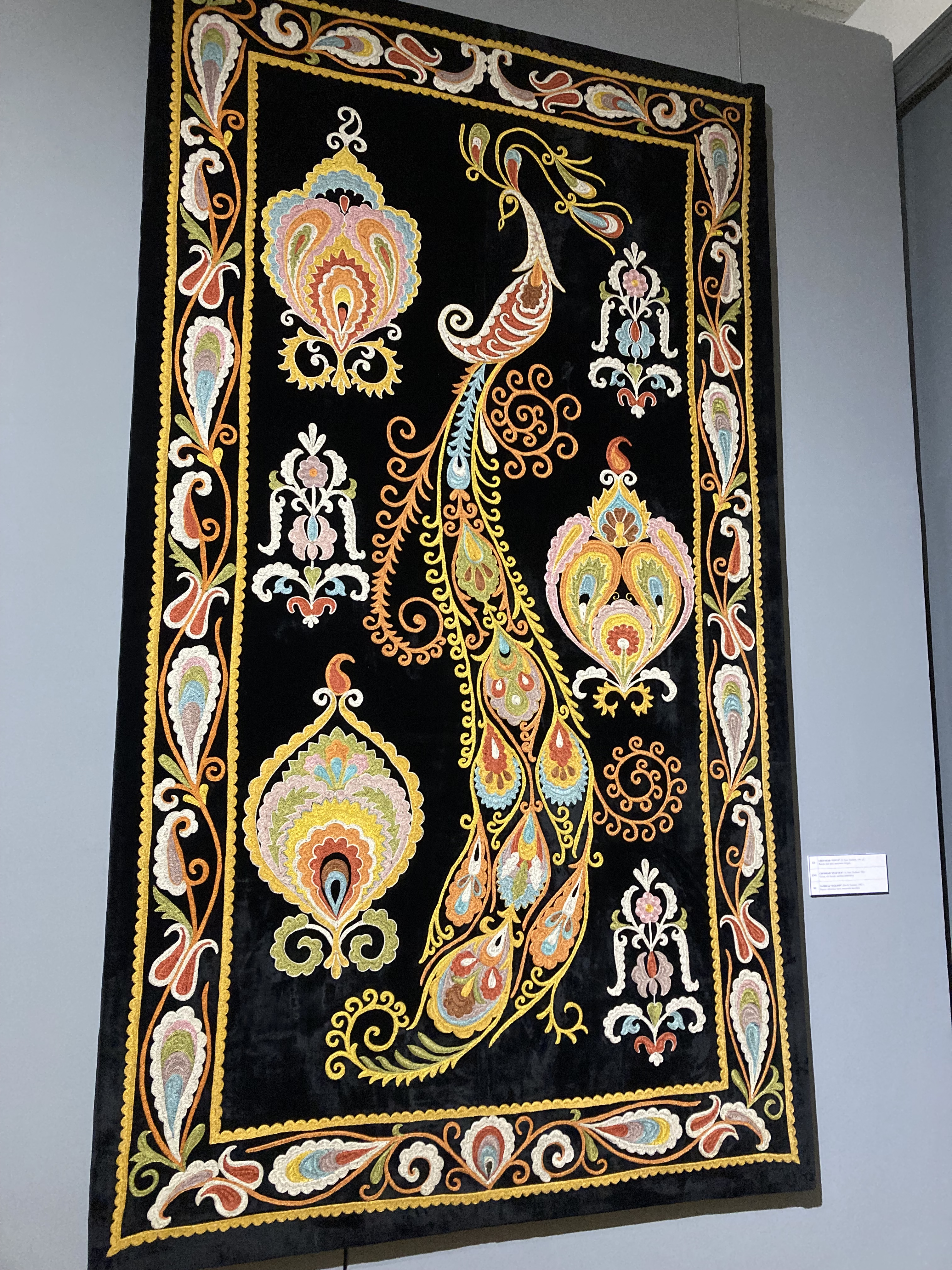
Meanwhile, we were also exposed to the glory that are “suzanis,” embroidered textiles heavily associated with traditional Uzbek culture and the surrounding cultures of Afghanistan and Tajikistan. I lost count of how many different suzani shops we walked into during our whirlwind tour through Uzbekistan, but that might have been just because I was getting my brain relentlessly baked in the blazing sun. After much searching, Adrinne eventually purchased a suzani of her own, which will be a great remembrance of this trip and an emblem of how traditions persevere across time.


_______________
These experiences demonstrated on a macro level how things can last even after their time has come and gone. But both Adrienne and I also got to see how this concept has played out in our lives and the lives of our families.
One of our first stops following Oceania was Thailand, and this wasn’t by chance. Approximately 45 years ago, Adrienne’s father, Tim, had gone to Thailand for the Peace Corps. He had been deployed to a small village named Wiang Pa Pao, located just outside of Chiang Rai. And while there, had worked on public health initiatives but also taught English for a time.


After we got a chance to poke around Bangkok, which I disliked, and Chiang Mai, which I loved, Adrienne and I headed that way in order to retrace Tim’s steps. We posted up in Chiang Rai and, after some serious temple viewing, hired a car to get us to Wiang Pa Pao. It was a long yet quite scenic journey, and one that I am very glad we ended up taking. Not only did we get the chance to visit where Tim had taught all those years ago, but we also met his former boss, Chuchat, and also one of his former students, whose name is Luck.
An exceptionally kind woman, farmer and Little House on the Prairie fan, Luck was very gracious with her time. She took us to her house while we were in Wiang Pa Pao and showed us around the town. It was fascinating to hear her memories of being taught by Tim. She clearly looked back on the time fondly and could recall quite a bit from events that occurred decades ago. I barely can remember my past teachers’ names, and sometimes, my own name, so I was very impressed.
Being in Wiang Pa Pao, I thought a lot how Tim’s experiences there might have influenced Adrienne today. There is no question having a parent who joined the Peace Corps, especially when the program was in its relative infancy, would impact how you see the world growing up. It seems credible that it would encourage a global perspective and a curiosity for others whose lives may be quite different from your own. Adrienne has personified those traits as long as I have known her, and our trip to Wiang Pa Pao was a unique opportunity to see one of their potential origin points.
_______________


Months later, it was my turn. Once we had seen enough of Central Asia, we bopped over to Istanbul to do things like tour the Hagia Sofia and the Basilica Cistern and develop a deep-seeding loathing for humanity in the process. We then took a flight to Bucharest, Romania. Part of my family, you see, is originally from that country, and I wanted to return in order to investigate that past and see if I could connect with it. As it turns out, I would connect on a level far deeper than I ever imagined.


The “family” in question is mostly represented by my great grandmother, Martha/Marta Biro/Yanisch. In 1921, Martha immigrated from a tiny village of Enlaka/Inlăceni, taking a boat from Hamburg all the way to Canada before later crossing into the United States. Enlaka sits nestled in a valley adjacent to the Firtos Mountain. It is a highly rural location approximately two hours to the northeast of the fortified city of Sighisoara.
Getting there was not what you would call easy. Adrienne and I had to take a train from Bucharest to Sighisoara and then hired a driver to take us the rest of the way. It turned out to be a stunning drive, filled with rolling, lush mountains, pockets of thick trees and tons of verdant farmland. The drive reinforced how isolated Enlaka truly is, as we passed huge stretches where there was little to no sign of human development. Eventually, we made it to the town itself. As Enlaka’s distinctive homes sitting on rising ground finally came into view, our sweet and wonderful driver that day asked, with great confusion, if we were, “going to a wedding.”
We had told our driver that our final destination was Enlaka’s central church, the Énlaki Unitárius Egyházközség. It turned out to be a good decision, as it gave us an easy point of reference to navigate toward, and the church was also beautiful: its stark, chalk-white facades powerfully contrasted against the green hills and deep blue skies.
The church proved highly useful for the overarching purpose of the trip as well. Situated on top of a hill and surrounded on three sides by a graveyard, Adrienne and I were able to immediately start searching for familial connections. In a matter of minutes, we clocked that we were surrounded by dead Biros and also by those who shared the surname of my great great grandmother, Berta Rofai. It took some additional searching, but we eventually identified the likely grave of my great great grandfather, Denes Biro. It turns out, Denes was born only four years after the end of the Civil War and died during the beginning of the Kennedy Administration.


Following our graveyard search, we conferred with our driver. He offered to call the pastor of the Énlaki Unitárius church, Tímea Mátéfi, to see if we could dig up some more details on my family’s history in the village. Mátéfi wasn’t able to meet that day, but we did connect a few days later on Facebook. In her messages, she kindly offered to connect me with distant relatives who still live in the area and even passed along additional documents about the line of Biros and Rofais that I descend from. These included a family register and a confirmation class list, which further fleshed out my great grandmother’s story and her life before departing for America.
Because we couldn’t connect with Pastor Mátéfi, Adrienne and I instead took a walk around the village. Enlaka is so small, you see, that you can easily accomplish this in an hour or so. Our walk was perhaps the most evocative and meaningful part of the trip for me. It was riveting and spooky to almost literally walk in my great grandmother’s footsteps and to see things she perhaps saw all those years ago as a young girl.


Walking around the village was also like stepping back in time. Deeply bucolic and agricultural, much of Enlaka appeared to be largely unchanged from the time my great grandmother lived there. The roads are largely unpaved, and many of the homes date back at least a few hundred years.
As likely the first of my family to return to Enlaka in over a century, I had joked many times to Adrienne that the second we stepped foot inside the town’s limits, a great shout would go up, a collective cheer that one of Enlaka’s wayward sons had returned. In reality, we saw more dogs than people during our route. The silence of the place was deep and total, punctuated by the whistle of the wind, the occasional whir of a table saw and the stray moo from a cow or two once we got near the village’s border.
In the days leading up to my visit to Enlaka, I had been collecting other documents about my great grandmother’s journey to America. I had found things such as the birth registrar; the passenger manifest of her trip on the Empress of France, which departed from Hamburg; her certificate of arrival from when her ship docked in Quebec, Canada; her border crossing into the United States and even documents pertaining to her later experience in America, such as her petition for citizenship and naturalization papers.
On one hand these documents exuded a legal, sterile energy, where complex human lives are reduced to a few dates, stats and milestones. But I did find glimmers of humanity here and there. I learned how my great grandmother left everything she knew at the age of just 14, arriving in America with nothing more than $5 in her pocket (about $30 today) and a profession listed simply and sweetly as “House girl.”
I have no memory of my great grandmother. She died when I was just four years old in 1992. But I do of her daughter, my grandmother, who passed away 15 years later in 2007. I was never close with my grandmother and found her to be a rather cold, withholding person. I could be wrong, but given her demeanor, I’ve never imagined my great grandmother as being much warmer.
This is how I have long thought about her and my ancestors in general. But after reading more about her daunting immigration journey, as well as visiting the small town she left behind, I now feel something else: powerful empathy. I also feel a profound sense of gratitude.
Now, I am the last person who will say you should ever feel indebted to your predecessors. Making the lives of those who come after you a bit easier is the bare minimum you can do with your short time on Earth.
Still, two things can be true at once. I can both acknowledge that it was her responsibility while still appreciating the grit, bravery and effort leaving Enlaka must have taken, as well as its subsequent impact. By taking on such an epic journey, my great grandmother set off a chain of events. And these events are at least partially responsible for the very nice life I now enjoy. A life that is far more comfortable than she could likely ever have imagined growing up in Enlaka at the dawn of the 20th century. Or to put it another way, because she made the consequential decision to leave her home, I am now privileged enough to return to it.
_______________
Bearing all this in mind, I guess if there is one takeaway from this trip it is simply this. It doesn’t matter how many photos you take, you don’t have to go far in this old world of ours to learn how everything is eventually whittled to dust. But you also don’t have to go far in this world to discover ways to live with that fact. We can be like innocent beans of light, otherwise known as animals, living safely in full awareness of the present moment and blissfully free from ego. And we can remember that while everything dies, nothing ends. It goes on one way or another. And so do we.

As you’ve now seen, pretty much everywhere we went that latter message was spelled out to us. But I don’t think anywhere did so more succinctly than in where we began this particular blog: the great city of Sydney. There is an outdoor sculpture there called Memory is Creation Without End. The work consists of fragments of antiquated buildings embedded in the ground framed by Sydney’s modern skyline. To me, the sculpture vividly showed how everyone’s part in this story will come to a close, and what’s old must always give way to what’s new. But rather than fade away, the old is what seeds the ground and is later reflected in what comes next. And this is a process that never dies. It occurs over and over—forever. These thoughts can’t fix one of the most horrifying things about the human condition. But they are real. And they are vital. If only because they may be all we’ve got.
______________
And with that, we will leave it there. As I write this, I am sitting in the office of my little home in St. Paul. We made it back if you can believe it. And so, I know I say this every time, but this may ACTUALLY be the final entry in this blogging series. But don’t despair, my friends. I have now blogged about a good 80% of our journey; so, you won’t be missing much. I may write one final entry, an epilogue of sorts summing up the final three countries on our trip: Great Britain, France and Germany’s Black Forest. I think there may be something there about touring three former empires as the one I am a citizen of continues to crumble. But who knows? Like everything, time will tell.
_________________________


Amazing recap, such thoughtful, inspiring insights. As always, I’m in awe of your writing. Love you, testvér.